
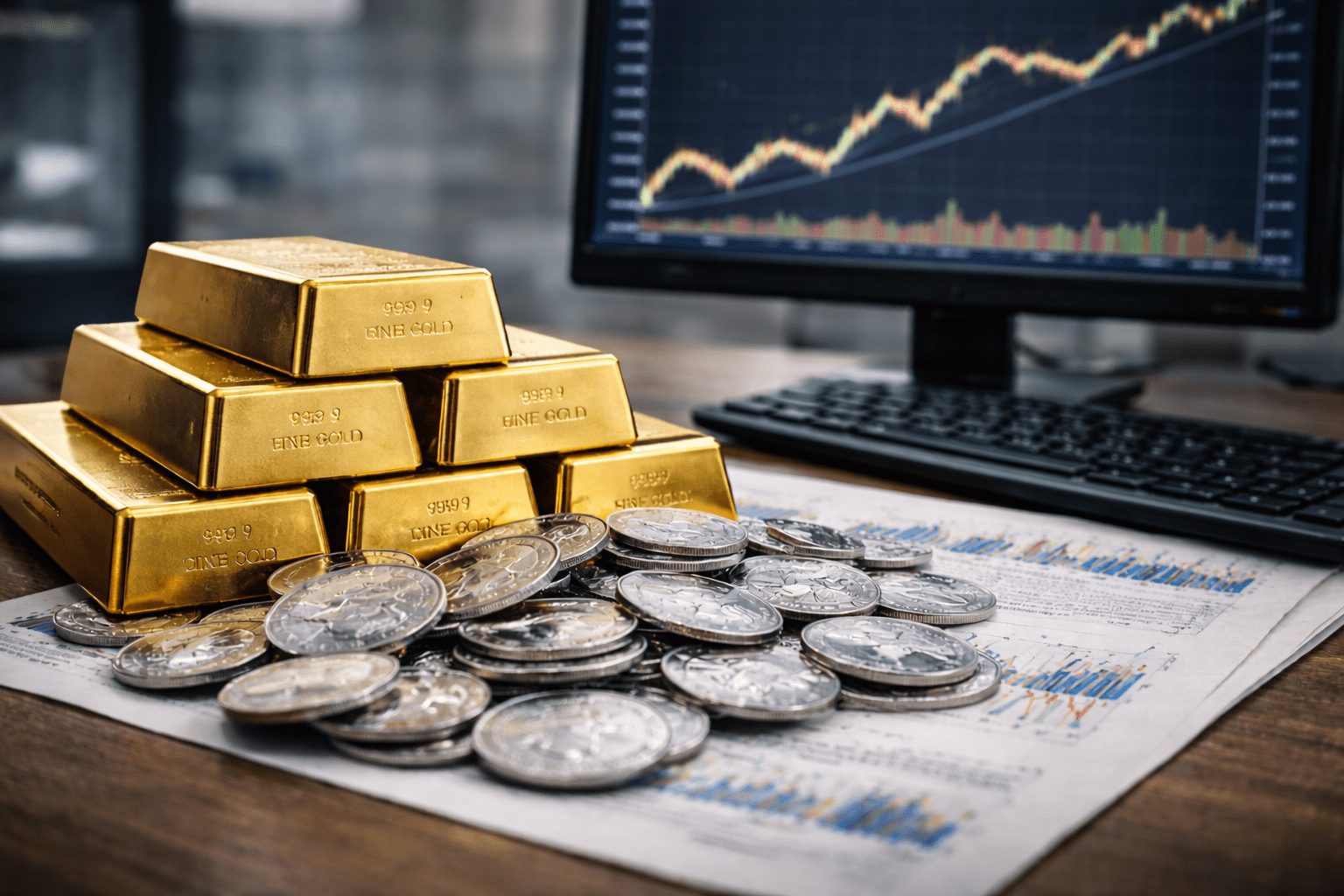
Gold prices slid more than 3%, and silver plunged over 10% on Friday as sentiment in the precious metals market soured drastically.
Oil prices, on the other hand, climbed more than 2% due to rising concerns about a prolonged supply disruption in the Strait of Hormuz.
Meanwhile, copper’s retreat from its record-high close continued, driven by two key factors: a stronger US dollar, which makes the metal pricier for international buyers, and accelerating US inflation, which diminishes the likelihood of interest rate reductions.
Precious metals rout
Gold’s appeal diminished, leading to a drop of over 2% on Friday, driven by a surge in Treasury yields and a stronger US dollar.
Simultaneously, ongoing tensions in the Middle East and higher oil prices solidified expectations for sustained higher interest rates.
At the time of writing, the COMEX gold contract was at $4,532 per ounce, down 3.3%, while silver was 10.1% lower at $76.770 an ounce.
The strengthening dollar made gold, which is priced in the US currency, more costly for international investors.
Additionally, the rise in the benchmark 10-year US Treasury yields to almost a one-year peak lessened the appeal of holding non-yielding gold.
The closure of the Strait of Hormuz has caused Brent crude oil prices to surge, climbing 7.8% this week to trade above $109 a barrel.
These elevated fuel costs contribute to inflationary pressures as manufacturers transfer the increase onto consumers.
Consequently, central banks are compelled to maintain high interest rates, which lessens the attractiveness of non-yielding gold.
Recent inflation data indicate that both consumers and businesses are beginning to experience significant price pressure increases, a development linked to the war.
Consequently, according to the CME’s FedWatch Tool, traders have mostly eliminated the expectation of US interest rate cuts this year.
“The new Fed Chair, Warsh, who takes office today, may therefore find it difficult to convince a majority within the FOMC to cut interest rates,” Carsten Fritsch, commodity analyst at Commerzbank AG, said.
Oil climbs
Hopes for a resolution to the ship attacks and seizures near the Strait of Hormuz were further diminished following statements from US President Donald Trump and Iran’s foreign minister on Friday, resulting in approximately a 2% increase in oil prices.
The Brent crude oil contract was last at $108.35 per barrel, up 2.5%, while the West Texas Intermediate was at $103.95 per barrel, up 2.8%.
Over the week, Brent has climbed 7%, and WTI has risen over 9% on uncertainty over the shaky ceasefire in the Iran conflict.
“The tone between the US and Iran has once again become significantly more confrontational. While the ceasefire holds, hopes for a swift reopening of the Strait of Hormuz have faded,” Barbara Lambrecht, commodity analyst at Commerzbank, said.
Iranian Foreign Minister Abbas Araqchi stated on Friday that Iran is ready for diplomatic solutions but also prepared to resume fighting.
He emphasized that Iran has “no trust” in the US and is only willing to negotiate with Washington if the US demonstrates seriousness.
Expressing his dwindling patience with Iran, Trump stated that he and Chinese President Xi Jinping had reached an agreement: Iran must not be permitted to develop a nuclear weapon and must ensure the Strait of Hormuz is reopened.
While President Xi offered no personal commentary on his Iran discussions with Trump, China’s foreign ministry released a statement declaring, “This conflict, which should never have happened, has no reason to continue.”
Regarding the anticipated outcomes of the US-China summit, Trump mentioned that China is interested in purchasing oil from the United States.
Furthermore, he suggested he might be willing to lift sanctions currently imposed on Chinese companies that buy oil from Iran.
Copper
Copper prices continued to fall after retreating from a record high, primarily due to accelerating US inflation.
This inflation has lessened the likelihood of interest rate cuts and strengthened the dollar, making the metal more costly for international buyers.
Analyst Gao Yin noted that the combination of a stronger dollar and rising US Treasury yields points to reduced expectations for rate cuts, which is driving down metal prices.
Copper prices near record highs have likely started to deter demand in China, with fabricators seeing orders weaken this month.
Meanwhile, the Argentine government has approved two new mining projects under the Large Investment Incentive Regime (RIGI), as announced by Minister of Economy Luis Caputo on social media.
The approved projects are the San Jorge copper mine in Mendoza Province, which involves an investment of $891 million, and the $1.2 billion expansion of the Cauchari Olaroz lithium mine in Jujuy Province.
These two projects are expected to generate over 8,000 new direct and indirect jobs.
At the time of writing, the three-month copper contract on the London Metal Exchange was at $13,526.30 per ton, down 3.2% from the previous close.
The post Commodity wrap: Gold dives 3%, silver sinks 10% as oil climbs on Hormuz fears appeared first on Invezz