
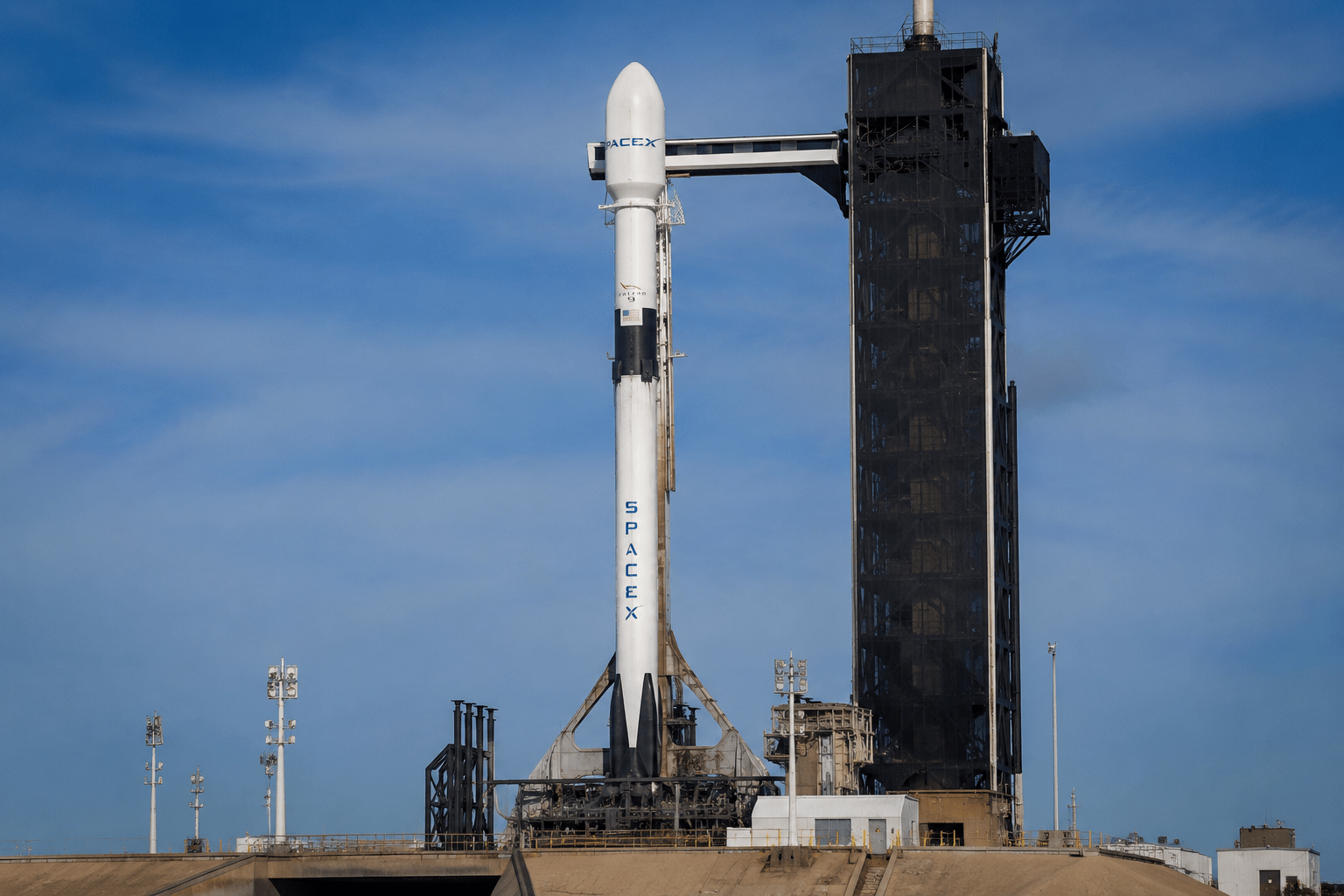
The long-awaited public debut of SpaceX has finally arrived, triggering one of the sharpest divisions among market experts in recent memory.
The Elon Musk-led space company is expected to price its initial public offering on Thursday before beginning trading on Friday.
With an anticipated valuation of roughly $1.75 trillion, SpaceX would instantly become one of the world’s most valuable publicly traded companies.
Investor appetite appears overwhelming.
Reuters, citing people familiar with the matter, reported that the company has attracted more than $250 billion in demand despite seeking to raise around $75 billion.
According to the report, the offering is between three-and-a-half and four times oversubscribed.
The extraordinary demand reflects investor enthusiasm for a company that has transformed commercial space launches, built the world’s largest satellite internet network through Starlink, and is pursuing ambitious plans ranging from orbital data centers to eventual human settlement on Mars.
Yet despite the excitement, analysts remain deeply divided on whether the stock’s valuation is justified.
Tesla bull sees a 22% upside from the offering price
Among the more optimistic voices is New Street Research analyst Pierre Ferragu, who initiated coverage of SpaceX without a formal rating but assigned a price target of $165 per share.
While investors know the IPO is expected to price at $135, Ferragu noted that uncertainty remains around where the stock could ultimately trade once it reaches public markets.
His $165 target implies roughly 22% upside from the offering price and values the company at approximately $2.3 trillion.
Ferragu’s outlook is built on aggressive long-term growth assumptions.
According to estimates cited by ratings aggregators, he expects SpaceX to generate about $195 billion in revenue and $65 billion in operating profit by 2030.
Those forecasts place SpaceX at roughly 35 times projected 2030 operating profit, a significant premium to technology giants such as Alphabet, which currently trades at around 13 times estimated 2030 operating profit.
The comparison is appropriate because both companies are heavily investing in artificial intelligence infrastructure.
Alphabet is spending aggressively on AI data centers, while SpaceX is pursuing a more unconventional vision.
Musk has argued that data centers deployed in orbit could eventually become cheaper and more efficient to operate than facilities on Earth.
Embedded within Ferragu’s valuation is an estimated $650 billion contribution from Starlink-related businesses and another $575 billion tied to AI opportunities.
If those initiatives develop successfully, he believes SpaceX shares could ultimately be worth as much as $330.
The analyst is well known for taking long-term bullish positions on Musk-led companies.
He currently maintains a Buy rating on Tesla and holds one of Wall Street’s highest price targets on the electric vehicle maker at $600.
Although formal analyst coverage is still limited because most Wall Street banks involved in the IPO must wait before publishing research, alternative markets have offered clues about investor sentiment.
Late Wednesday, SpaceX-linked share futures traded around $163 on cryptocurrency trading platform Hyperliquid.
The contracts, known as perpetual futures, allow investors to speculate on stock prices using leverage and have emerged as an informal price-discovery mechanism ahead of the IPO.
The futures pricing aligns closely with Ferragu’s valuation and suggests many investors expect shares to trade well above the offering price once public trading begins.
Whether that enthusiasm holds after the opening session remains to be seen.
Morningstar warns investors may be overpaying
Morningstar analyst Nicolas Owens has emerged as one of the most vocal skeptics, arguing that SpaceX is significantly overvalued at its IPO price.
In a note published this week, Owens assigned the company a fair value estimate of $63 per share, roughly 53% below the reported offering price.
According to Owens, the gap between his valuation and the IPO price largely reflects investors paying for highly speculative future projects rather than the company’s existing operations.
While acknowledging SpaceX’s technological leadership, he argued that much of the offering price resembles an option premium tied to ambitious initiatives such as orbital AI data centers and future Mars infrastructure.
“The more likely you believe cost-competitive orbital AI data centers will be, the closer to the offering price a reweighted valuation of SpaceX gets, and those extra projects could be seen as free options,” he wrote.
The central disagreement between bulls and bears appears to revolve around whether SpaceX can successfully build profitable data centers in space.
Owens believes these projects have a major influence on investor expectations.
Under his most optimistic scenario, SpaceX could eventually achieve a valuation of $1.97 trillion, equivalent to about $154 per share.
That outcome assumes the company proves orbital data centers are both technically feasible and economically superior to terrestrial facilities.
However, he noted that scientific uncertainty remains substantial.
His base-case scenario assumes a “minimum viable product” outcome with a 50% probability.
Under that framework, orbital data centres work but remain constrained in scale, allowing SpaceX to capture roughly 4% of global AI computing capacity and generate approximately $47 billion in annual AI-related revenue by 2035.
The most pessimistic outcome, which Owens assigns a 43% probability, assumes orbital data centers fail to deliver meaningful advantages or never become commercially viable.
“We surmise that the company, having invested tens of billions to find this out, would cut bait on the project sometime around 2028, the way management walked away from plans to build multiple small-car factories at Tesla,” wrote Owens.
Lockup structure adds another layer of uncertainty
Owens also pointed to SpaceX’s unusual lockup structure as a potential risk for early investors.
Unlike traditional IPOs, where insiders typically face a six-month restriction on selling shares, SpaceX will allow certain existing shareholders, excluding Musk, to sell portions of their holdings within weeks of the listing and periodically through December.
That structure could increase share supply sooner than investors are accustomed to seeing in newly listed companies.
As a result, Owens believes patient investors may eventually receive a more attractive entry point.
“We think long-term investors eager to participate in SpaceX’s future endeavors and potential success will have opportunities to do so with more margin of safety than the initial offering is likely to provide,” he wrote.
For now, the SpaceX IPO represents far more than a public listing.
It is a referendum on some of the boldest technological ambitions in business today.
Whether investors are buying the future of space exploration, AI infrastructure, and Mars colonisation, or simply paying too much for a dream, may become one of the market’s defining debates in the years ahead.
The post SpaceX IPO's valuation battle has bulls aiming share at $165 while bears see $63 appeared first on Invezz