
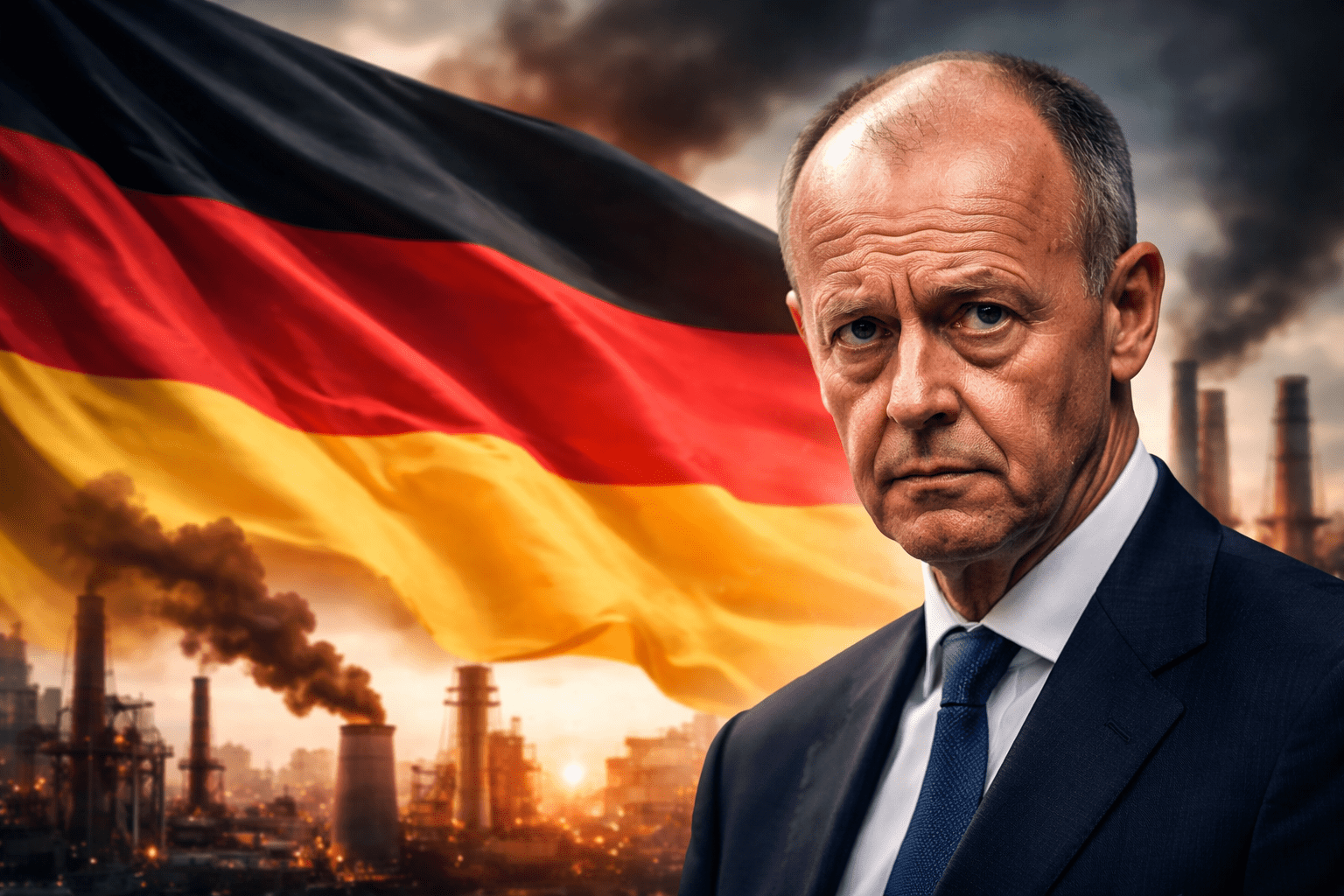
Germany is in the midst of a slow-motion economic unravelling — one that is almost entirely self-inflicted.
Once the uncontested engine of European prosperity, the country now posts some of the weakest growth among advanced economies, has watched its industrial base wither, and faces a political crisis driven by a governing class too timid to confront the problems it helped create.
What the numbers tell us
Germany’s GDP contracted by 0.5% in 2024 — its second consecutive year of negative growth.
It technically exited recession in 2025 with a meagre 0.2% expansion, the economic equivalent of a pulse, but little more.
Industrial production fell by 1.9% month-on-month in December 2025 alone, while unemployment stood at 6.3% as of February 2026.
The European Commission forecasts growth of just 1.2% for 2026 — below the EU average of 1.4% — driven largely by government spending rather than a genuine private-sector recovery.
Chancellor Friedrich Merz himself described parts of the German economy as being in a “critical condition” on 1 January this year.
He was not wrong.
The energy decision that changed everything
In 2002, Germany passed legislation to close all of its nuclear power plants by 2022.
The assumption was that renewable energy would be ready to bridge the gap. It wasn’t.
When Angela Merkel briefly reversed course in 2010, extending plant lifetimes by twelve years, the Fukushima disaster in Japan ended that reprieve within weeks.
Eight reactors were shut down immediately; the rest followed by 2023.
The scientific argument for keeping them operational was straightforward: Germany has no tsunami-exposed coastline, lies on stable continental crust, and faces virtually no earthquake risk.
The conditions that led to Fukushima simply do not exist in central Europe. France grasped this; Germany chose not to.
With nuclear power gone and renewables still unable to supply consistent baseload energy, Germany turned to Russian pipeline gas to fill the shortfall.
By 2021, Russia provided 55% of Germany’s natural gas.
When Russia invaded Ukraine in February 2022, and gas flows were restricted before the Nord Stream sabotage that September, German electricity prices soared — reaching €820 per megawatt hour by late 2024.
France, with its nuclear fleet still in operation, saw wholesale prices of roughly €100 to €150 per megawatt hour at peak demand.
Today, Germany’s industrial electricity price stands at €0.199 per kilowatt hour, compared with around $0.075 in the United States and $0.082 in China
Who is actually leaving and why it matters?
BASF, the world’s largest chemical company by sales, announced a $10 billion investment in China.
Not a partnership, not a pilot venture — a full-scale $10 billion capital shift away from Germany.
The company’s chief executive has long been openly critical of German energy policy, and this move is the clearest indication yet that the industrial exodus is no longer theoretical.
Germany recently recorded a trade deficit with China of €66.3 billion, having once run a consistent surplus.
For years, Germany’s formula was simple: sell precision machinery and premium cars to a developing China that was building its manufacturing base. But China has now built it.
Chinese firms produce their own industrial robots, electric vehicles and solar panels.
Germany’s largest customer has become its most capable competitor — and Germany’s high energy costs have only smoothed that transformation.
Manufacturing’s economic value added peaked in 2017 and has since fallen by 7%, while industrial production and sales are both down nearly 15% from their highs.
Germany’s political vacuum
Friedrich Merz entered the chancellorship in 2025 with genuine public goodwill and a clear reform mandate.
By June that year, most Germans approved of his early performance.
Since then, his ratings have collapsed: just 23% favourable and 71% unfavourable, according to YouGov’s February 2026 European tracker.
His party has pursued what insiders describe as a “Ming vase” strategy — say nothing bold, break nothing, and hope to glide through a crowded regional election calendar.
On 8 March, the CDU lost Baden-Württemberg despite holding an eight-point lead in the polls.
The state — home to Mercedes-Benz, Porsche and Bosch — is an industrial heartland where deindustrialisation dominates voter concerns and trust in the CDU’s economic competence remains strong.
Yet the Greens claimed victory with a candidate who hid his party logo on campaign posters and called for tighter immigration controls.
The AfD doubled its vote share to 19%, its best-ever result in a former West German state, drawing heavily from disaffected CDU voters.
More than 80% of Germans believe the pension system is dysfunctional. Nearly 80% say the economy is in poor shape. Over 60% favour stricter immigration controls. These should be core CDU issues.
When Merz’s younger MPs pressed for pension reform, he dismissed them, saying, “You can’t be serious. Such things don’t win elections.”
The €500-billion question
In March 2025, parliament approved a €500 billion special infrastructure fund, together with a constitutional exemption allowing defence spending to bypass the country’s debt brake.
Goldman Sachs, the European Commission and the Ifo Institute all forecast GDP growth of between 1.1% and 1.3% for 2026, and the funding is indeed real.
Yet Goldman Sachs is explicit: the growth it expects is “mainly cyclical”, not structural.
Germany’s nuclear capacity is gone for good.
The Südlink north–south transmission line — crucial to connecting northern wind power to southern industry — will not be completed until at least 2028, after Bavaria insisted it be buried underground at four to ten times the cost.
The pension system remains unreformed, and the demographic curve — a projected workforce decline of seven million by 2035 — cannot be reversed by spending alone.
Germany retains immense institutional depth, a world-class engineering culture and now the fiscal firepower to recover.
What it lacks is a government willing to use any of it for something beyond the next election.
The post Why Germany’s economy is collapsing faster than anyone expected? appeared first on Invezz